Can You Get Braces With Dental Implants?

Are Dentists Open in Level 3?
July 16, 2026
Are Titanium Dental Implants Safe? What You Should Know
August 19, 2026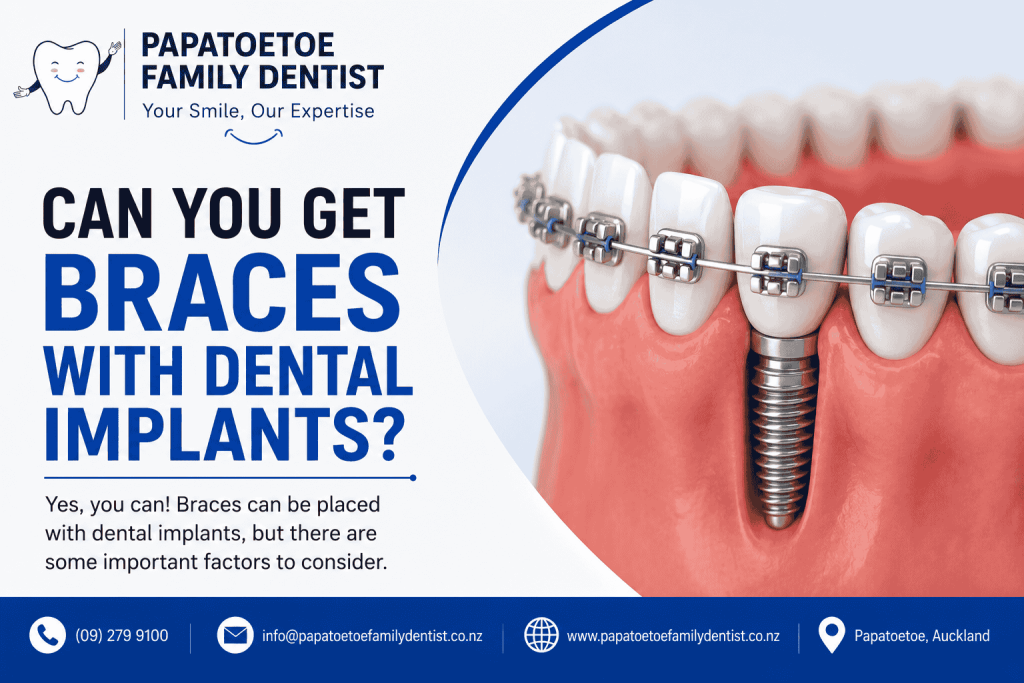
If you have dental implants and are considering orthodontic treatment, you may wonder: “Can you get braces with dental implants?“
The answer is yes, in many cases, you can have braces if you have dental implants. However, treatment planning is more complicated because a dental implant is fixed permanently to the jawbone and does not move like a natural tooth.
Whether braces are suitable depends on the location of the implant, the position of your natural teeth, your bite, and your overall orthodontic goals.
Can Braces Move Dental Implants?
No.
This is one of the most important things to understand.
Natural teeth are held in place by a periodontal ligament that allows them to gradually move when orthodontic forces are applied.
A dental implant is directly integrated with the jawbone through osseointegration. Because of this, the implant generally does not move in response to normal orthodontic forces.
Your orthodontist can move the natural teeth around the implant, but the implant itself normally remains in its original position.
Why Does the Location of the Implant Matter?
The position of your dental implant is very important when planning braces.
Implant Behind Your Natural Teeth
If the implant is located away from the teeth that need to be moved, orthodontic treatment may be relatively straightforward.
Implant Between Natural Teeth
An implant positioned between natural teeth can make treatment more complicated if the surrounding teeth need significant movement.
Implant in the Front of the Mouth
Front teeth are particularly important for appearance and bite alignment. An incorrectly positioned implant can limit orthodontic options.
Your orthodontist may use X-rays or 3D imaging to evaluate the implant and surrounding structures before treatment.
Can Braces Be Attached to a Dental Implant?
Orthodontic brackets can sometimes be attached to an implant crown or other implant components for specific purposes, but the implant itself cannot be moved like a natural tooth.
In some treatment plans, the implant can actually be used as a stable anchorage point to help move nearby natural teeth.
Your orthodontist will determine whether this approach is appropriate.
Why Might Someone Need Braces After Getting an Implant?
There are several reasons.
To Straighten Remaining Teeth
You may have received an implant for one missing tooth but later decide that you want to straighten the rest of your teeth.
To Improve Your Bite
Orthodontic treatment can sometimes improve:
- Overbite
- Underbite
- Crossbite
- Crowding
- Spacing
To Prepare for an Implant
In some cases, orthodontic treatment is actually completed before an implant is placed.
This can create enough space and improve the alignment of surrounding teeth.
Is It Better to Get Braces Before Dental Implants?
Sometimes, yes.
If you know you need both orthodontic treatment and a dental implant, your dentist and orthodontist may recommend completing braces first.
This is because natural teeth can be moved into their ideal positions before the implant is placed.
Once an implant is integrated with the bone, it generally cannot be moved orthodontically.
What If You Already Have Dental Implants?
Don’t worry. Having an implant doesn’t automatically mean you can’t get braces.
Your orthodontist can assess:
- Implant location
- Number of implants
- Position of natural teeth
- Jawbone condition
- Bite alignment
- Overall oral health
A customised treatment plan can then be created.
Can Invisalign Be Used With Dental Implants?
In some cases, yes.
Clear aligners can move natural teeth while leaving the implant in place.
However, the same basic principle applies: aligners cannot move an osseointegrated dental implant.
Your orthodontist will design the aligners around the implant and plan the movement of your natural teeth accordingly.
What Are the Challenges?
Orthodontic treatment with dental implants can be more complex because:
- Implants don’t move
- Space may be limited
- Bite correction may be more difficult
- Treatment may require additional planning
For this reason, it’s important to have your dentist and orthodontist work together.
How Long Should You Wait After Getting an Implant Before Braces?
There’s no single waiting period that applies to everyone.
The implant needs sufficient time to heal and integrate with the surrounding bone before it is used as part of a treatment plan.
Your dentist or oral surgeon will determine when the implant is stable enough based on:
- Healing
- Bone integration
- Implant stability
- Overall oral health
What If I Need an Implant During Orthodontic Treatment?
Sometimes the implant is placed after braces rather than before them.
This can be beneficial because your orthodontist can first create the correct space and alignment.
The implant can then be placed in the final planned position.
Frequently Asked Questions
Can you get braces if you have dental implants?
Yes. Many people with dental implants can receive orthodontic treatment, although the treatment plan must account for the fact that implants don’t move.
Can braces move a dental implant?
No. A properly integrated dental implant is fixed to the jawbone and cannot be moved like a natural tooth.
Can you get Invisalign with dental implants?
Yes, in many cases. Invisalign can move natural teeth around an implant, but the implant itself will remain in place.
Should I get braces before or after dental implants?
If both treatments are needed, orthodontic treatment is often planned first so natural teeth can be positioned correctly before the implant is placed. However, the best sequence depends on your individual case.
Final Thoughts
If you’re asking “Can you get braces with dental implants?”, the answer is yes, in many cases. The key difference is that braces can move your natural teeth but generally cannot move an integrated dental implant.
If you are considering both treatments, it’s best to have your dentist and orthodontist plan the treatment together. In some cases, braces may be recommended before an implant is placed, while in others, orthodontic treatment can be safely performed around an existing implant.
A thorough examination and appropriate imaging will help determine the safest and most effective approach for your smile.
Dental clinics such as Papatoetoe Family Dentist can assess your existing dental implants and discuss whether orthodontic treatment may be appropriate for your individual needs.