What Is the Blue Light Used by Dentists?

Why Are Dentists Suicidal? Understanding Stress, Mental Health & Suicide Risk in Dentistry
August 19, 2026
How Often Should I Go to the Dentist?
September 3, 2026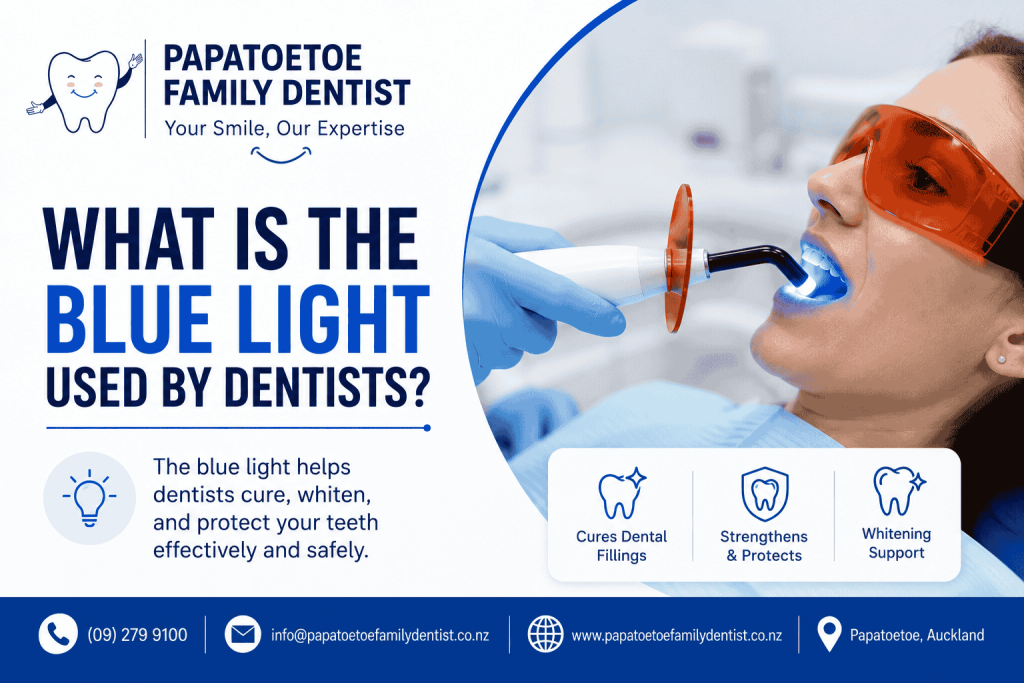
If you’ve ever visited a dentist and noticed a bright blue light being used during your treatment, you may have wondered: “What is the blue light used by dentists?”
The blue light is most commonly used to harden or cure certain dental materials, particularly tooth-coloured composite resin used for dental fillings and bonding. This process is called light curing or photopolymerisation.
In this guide, we’ll explain what the blue dental light does, why dentists use it, whether it is safe, and which treatments commonly require it.
What Is the Blue Light at the Dentist?
The blue light is produced by a device called a dental curing light or LED curing light.
It emits a specific wavelength of blue light that activates special ingredients called photoinitiators in dental materials.
When the light is directed at the material, it causes the material to harden within a short period.
What Is the Blue Light Used For?
The most common use is curing composite dental fillings.
Composite resin is initially soft and mouldable, allowing the dentist to shape it to match your tooth. The curing light then hardens the material so it can function like part of the tooth.
Dentists may also use the blue light for:
- Tooth-coloured fillings
- Dental bonding
- Veneer bonding
- Orthodontic brackets
- Dental sealants
- Certain dental cements
How Does Dental Curing Work?
The process is relatively simple.
Step 1: The Dentist Applies the Material
The dentist places composite resin or another light-sensitive material onto the tooth.
Step 2: The Material Is Shaped
The dentist carefully shapes the material to restore the tooth’s appearance and function.
Step 3: The Blue Light Is Applied
The curing light is positioned close to the tooth.
Step 4: The Material Hardens
The blue light activates the photoinitiator inside the material, causing it to polymerise and harden.
This usually takes only a few seconds per layer.
Why Does the Dentist Cure the Filling in Layers?
Composite fillings are often placed in several thin layers.
Each layer can be shaped and cured separately. This helps the dentist achieve:
- Proper strength
- Better adaptation to the tooth
- Accurate shaping
- A natural appearance
The dentist may repeat the process several times depending on the size and location of the restoration.
Is the Blue Dental Light Safe?
Yes. Dental curing lights are generally considered safe when used correctly.
Dentists and dental staff take precautions to avoid unnecessary exposure to the intense light.
Patients may be given protective eyewear, or the dentist may position the curing light so that you don’t look directly into it.
You should avoid staring directly at the curing light because it is very bright and can be uncomfortable for your eyes.
Does the Blue Light Hurt?
No. The blue light itself should not hurt.
You may notice:
- Bright light
- Mild warmth
- A little sensitivity from the tooth
However, the curing process itself is generally painless.
If you experience significant pain during a dental procedure, tell your dentist so they can check the tooth and make you more comfortable.
Why Does the Light Sometimes Feel Warm?
Dental curing lights produce intense light energy, and some of that energy can result in heat.
The dentist usually cures the material for a short period and may use appropriate techniques to control heat exposure.
Modern LED curing lights are designed to provide efficient curing while limiting unnecessary heat.
Can You See the Blue Light?
Yes. The light is usually very bright and has a distinctive blue or blue-violet appearance.
Your dentist may ask you not to look directly at it during treatment.
Is the Blue Light Used for Teeth Whitening?
This is where things can get confusing.
Some dental whitening systems may use light as part of the treatment, but the blue curing light used for fillings is not the same thing as a tooth-whitening treatment.
The curing light’s primary purpose is to harden dental materials.
Simply shining a dental curing light on your teeth will not automatically whiten them.
Why Do Dentists Use Blue Light for Composite Fillings?
Composite resin is popular because it can be matched closely to the natural colour of your teeth.
However, the material needs to be hardened after it is placed.
The curing light allows dentists to:
- Work with the material while it’s soft
- Shape it precisely
- Harden it quickly
- Restore the tooth in a controlled way
This makes composite fillings practical and aesthetically pleasing.
What Happens After the Filling Is Cured?
Once the filling has been completely hardened, your dentist checks the restoration.
They may:
- Shape the filling
- Polish the surface
- Check your bite
- Make small adjustments
The goal is to make the restoration feel as natural as possible.
Frequently Asked Questions
What is the blue light dentists use?
It is usually an LED dental curing light used to harden light-sensitive dental materials such as composite resin.
Does the blue light whiten teeth?
Not normally. The blue curing light used for fillings is primarily designed to cure dental materials rather than whiten teeth.
Can the blue dental light damage your eyes?
Looking directly into a high-intensity curing light should be avoided. Dental professionals use appropriate precautions to minimise unnecessary exposure.
How long does the blue light stay on?
It usually operates for several seconds at a time, depending on the material, curing light, and treatment.
Is dental curing light used for braces?
Yes. Curing lights can be used to harden the adhesive that attaches certain orthodontic brackets to teeth.
Final Thoughts
If you’ve ever wondered “What is the blue light used by dentists?”, it is most commonly a dental curing light used to harden materials such as composite fillings and dental bonding.
The process is quick, generally painless, and an important part of modern restorative dentistry. If you notice the blue light during your next dental appointment, there’s usually no reason to be concerned—it’s simply helping your dentist create a strong and durable restoration.