How Many Dental Specialties Are There?

How Long Does Dental Numbing Injection Last?
September 28, 2026
How Much Does a Dental Crown Cost in NZ?
September 28, 2026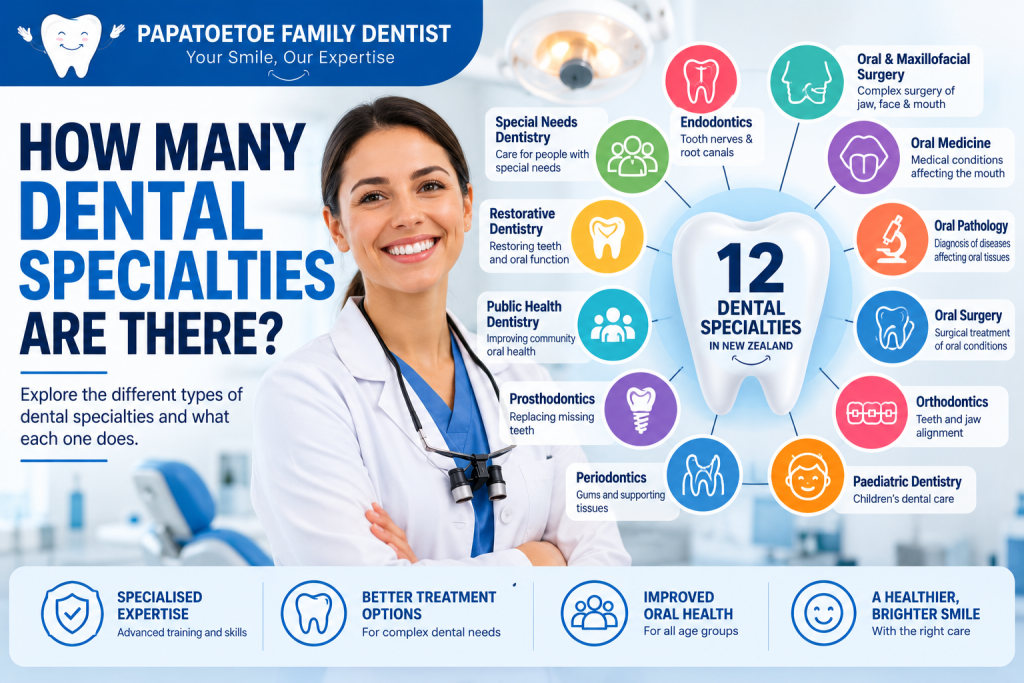
Dentistry is much broader than routine check-ups, fillings and tooth extractions. As dental science has developed, different areas of oral healthcare have become specialised, allowing dentists to receive advanced training in particular types of treatment.
So, how many dental specialties are there?
The answer depends on the country and the regulatory system being used. There isn’t one universal worldwide number because different countries officially recognise different dental specialties.
In New Zealand, the Dental Council currently lists 12 dental specialist scopes of practice. These are endodontics, oral and maxillofacial surgery, oral medicine, oral pathology, oral surgery, orthodontics, paediatric dentistry, periodontics, prosthodontics, public health dentistry, restorative dentistry and special needs dentistry.
General dental practice is separate from these specialist scopes. A general dentist provides a broad range of dental services, while a dental specialist has additional postgraduate qualifications, training and experience in a particular area.
At Papatoetoe Family Dentist, understanding the different areas of dentistry can help patients know which type of dental professional may be involved in different treatments.
Let’s take a closer look at the major dental specialties recognised in New Zealand and what each one does.
What Is a Dental Specialty?
A dental specialty is a particular area of dentistry that requires additional education and training beyond general dental practice.
A general dentist can diagnose and treat many common dental conditions. However, some cases are more complex and may require advanced knowledge or specialised procedures.
Dental specialists focus on specific areas such as:
- Tooth nerves and root canals
- Tooth alignment
- Gum disease
- Missing teeth
- Children’s dental care
- Oral surgery
- Oral diseases
- Complex medical conditions affecting oral health
In New Zealand, the Dental Council states that specialist practice involves additional postgraduate qualifications, training and experience recognised as appropriate for specialist registration.
How Many Dental Specialties Are There in New Zealand?
The Dental Council of New Zealand currently lists 12 dental specialist scopes of practice.
These are:
- Endodontics
- Oral and Maxillofacial Surgery
- Oral Medicine
- Oral Pathology
- Oral Surgery
- Orthodontics
- Paediatric Dentistry
- Periodontics
- Prosthodontics
- Public Health Dentistry
- Restorative Dentistry
- Special Needs Dentistry
It’s important to note that restorative dentistry is no longer available as a new specialist registration scope. The Dental Council states that only practitioners who were registered in this scope on 18 September 2004 may practise in it.
1. Endodontics
An endodontist specialises in problems involving the inside of the tooth, particularly the dental pulp and tissues surrounding the root.
The dental pulp contains nerves and blood vessels. When this area becomes infected or damaged, treatment may be necessary to save the tooth.
Endodontists commonly deal with:
- Complex root canal treatments
- Dental pulp disease
- Root-related infections
- Traumatic dental injuries
- Complicated cases involving previous root canal treatment
A general dentist can perform many root canal procedures, but particularly complicated cases may be referred to an endodontic specialist.
2. Oral and Maxillofacial Surgery
Oral and maxillofacial surgeons specialise in surgical conditions involving the mouth, jaws, face and associated structures.
Their work can involve significantly more complex procedures than routine dental surgery.
Examples include:
- Complex jaw surgery
- Facial trauma treatment
- Surgical treatment of jaw conditions
- Complex tooth removal
- Treatment of certain oral and facial defects
The Dental Council describes this specialty as dealing with the diagnosis and surgical treatment of diseases, injuries and defects involving the jaws and associated structures.
Because of the complexity of the specialty, training is extensive.
3. Oral Medicine
Oral medicine specialists focus on medical conditions affecting the mouth and surrounding oral and maxillofacial region.
These conditions may be associated with broader medical problems.
An oral medicine specialist may evaluate:
- Persistent mouth sores
- Oral mucosal conditions
- Chronic oral pain
- Medically related oral conditions
- Complex oral symptoms
Unlike oral surgery, oral medicine generally focuses on diagnosis and non-surgical management of these conditions.
The Dental Council specifically describes oral medicine as the area concerned with chronic and medically related disorders of the oral and maxillofacial region.
4. Oral Pathology
Oral pathologists specialise in diseases affecting the mouth, jaw and related structures.
Their work is often closely connected with diagnosis.
They may study tissue samples and other clinical information to help identify diseases affecting the oral and maxillofacial region.
Oral pathology is particularly important when a dentist or specialist identifies an unusual lesion or tissue change that needs further investigation.
The specialty focuses on understanding the nature and diagnosis of diseases affecting the oral and maxillofacial and adjacent regions.
5. Oral Surgery
An oral surgeon specialises in the surgical management of conditions affecting the mouth and tissues surrounding the teeth.
Oral surgery can include:
- Complex tooth extractions
- Surgical removal of teeth
- Treatment of oral conditions
- Certain minor oral surgical procedures
- Management of difficult dental cases
Oral surgery and oral and maxillofacial surgery are related but are recognised as separate specialist scopes in New Zealand.
The Dental Council describes oral surgery as focusing on the diagnosis and surgical management of conditions affecting oral and dento-alveolar tissues.
6. Orthodontics
Most people are familiar with orthodontists because of braces and teeth straightening.
Orthodontists specialise in correcting the position of teeth and jaws.
Treatment can involve:
- Traditional braces
- Clear aligners
- Retainers
- Bite correction
- Crowded teeth
- Spacing between teeth
- Jaw and dentofacial development
Orthodontic treatment isn’t only about making teeth look straighter. Correcting the position of teeth and jaws can also help improve function and bite.
The Dental Council defines orthodontics as including the diagnosis, prevention and treatment of different forms of malocclusion and related dentofacial problems.
7. Paediatric Dentistry
A paediatric dentist specialises in the oral health of children and adolescents.
Children have different dental needs from adults because their teeth and jaws are developing.
Paediatric dentists may provide care involving:
- Baby teeth
- Developing permanent teeth
- Tooth decay prevention
- Children’s dental anxiety
- Dental injuries
- Developmental problems
- Children with medical or behavioural conditions affecting dental care
The New Zealand Dental Council describes paediatric dentistry as covering oral healthcare for children from birth through adolescence.
Creating positive dental experiences during childhood can also help children develop healthy attitudes toward dental care.
8. Periodontics
A periodontist specialises in the gums and other tissues that support teeth.
Periodontal tissues include structures that help keep teeth stable within the mouth.
Periodontists may manage:
- Gum disease
- Advanced periodontal disease
- Gum recession
- Problems affecting supporting tissues
- Certain gum-related procedures
- Conditions involving tissues around dental implants
The Dental Council describes periodontics as the prevention, diagnosis and treatment of diseases or abnormalities affecting the supporting tissues of teeth or their substitutes.
Healthy gums are an important part of maintaining healthy teeth.
9. Prosthodontics
A prosthodontist focuses on replacing missing teeth and restoring damaged or deficient teeth.
This specialty can involve:
- Dental crowns
- Bridges
- Dentures
- Dental implants
- Implant-supported restorations
- Complex tooth replacement
- Full-mouth rehabilitation
Prosthodontics combines function, appearance and long-term oral rehabilitation.
The Dental Council describes prosthodontics as involving diagnosis, treatment planning, rehabilitation and maintenance for patients with missing or deficient teeth and/or craniofacial tissues.
Patients with multiple missing or severely damaged teeth may sometimes be referred to a prosthodontic specialist.
10. Public Health Dentistry
Public health dentistry, also known as community dentistry, takes a broader approach.
Instead of focusing primarily on treating one individual patient, public health dentistry focuses on improving oral health across communities and populations.
This can involve:
- Oral health promotion
- Disease prevention
- Community programmes
- Oral health research
- Public health policy
- Population-level dental initiatives
The goal is to reduce oral disease and improve oral health outcomes across larger groups of people.
The Dental Council describes this specialty as involving the prevention of oral disease, promotion of oral health and improvement of quality of life through organised community efforts.
11. Restorative Dentistry
Restorative dentistry focuses on restoring teeth and the function of the mouth.
It can include elements of:
- Operative dentistry
- Endodontics
- Periodontics
- Prosthodontics
- Orthodontics
This makes restorative dentistry a broad and complex area.
However, there is an important point for patients in New Zealand: restorative dentistry remains a recognised scope but is closed to new specialist registrants. Only practitioners registered in this scope on 18 September 2004 may continue to practise under it.
12. Special Needs Dentistry
Special needs dentistry focuses on people whose oral healthcare is affected by conditions such as intellectual disability or medical, physical or psychiatric issues.
These patients may require modified approaches to dental treatment.
Special needs dentists may work with patients who have:
- Intellectual disabilities
- Complex medical conditions
- Physical disabilities
- Psychiatric conditions
- Difficulties accessing conventional dental care
The specialty focuses on adapting oral healthcare to meet individual needs.
The Dental Council also notes that special needs specialists who want to identify specific expertise in hospital dentistry may apply to use the specialist title Special Needs Dentistry (Hospital).
Is a General Dentist a Dental Specialist?
No.
A general dentist and a dental specialist are different registration categories.
General dentists are trained to provide a broad range of dental care, including:
- Check-ups
- Fillings
- Preventive dentistry
- Extractions
- Crowns
- Basic root canal treatment
- Children’s dental care
- Dentures
- Emergency dental treatment
A dental specialist has additional training and is registered within a specific specialist scope.
The Dental Council specifically states that a registered dentist should not describe themselves as a particular dental specialist unless they are registered in the relevant specialist scope.
Do You Always Need a Dental Specialist?
No.
Many everyday dental problems can be diagnosed and treated by a general dentist.
A general dentist may refer you to a specialist when a case requires advanced expertise, specialised equipment or treatment outside the dentist’s scope or experience.
For example:
Crooked teeth:
You may be referred to an orthodontist.
Complex root canal:
An endodontist may be appropriate.
Advanced gum disease:
A periodontist may be involved.
Complex tooth replacement:
A prosthodontist may provide specialist care.
Complex oral surgery:
An oral surgeon or oral and maxillofacial surgeon may be involved.
The appropriate referral depends on the individual patient’s condition.
What Is the Difference Between a Dentist and a Dental Specialist?
The main difference is additional specialised training and the area of practice.
A general dentist provides comprehensive dental care across many areas.
A specialist focuses on a narrower field and completes additional postgraduate education and training recognised for specialist registration.
This doesn’t mean that every dental problem requires a specialist. General dentists are often the first point of contact and can determine whether specialist care is appropriate.
Can a Dentist Have More Than One Area of Interest?
Yes.
Dentists may develop additional skills or interests in areas such as:
- Cosmetic dentistry
- Implant dentistry
- Sedation dentistry
- Family dentistry
- Preventive dentistry
- Digital dentistry
However, having an interest or additional training in an area doesn’t necessarily mean that a dentist is officially registered as a specialist in that field.
This distinction is particularly important in New Zealand because specialist titles are regulated by the Dental Council.
Why Are There So Many Dental Specialties?
The mouth is a complex part of the body involving:
- Teeth
- Gums
- Jawbones
- Nerves
- Muscles
- Oral tissues
- Facial structures
Different conditions require different types of knowledge and treatment.
As dental science has developed, specialists have emerged to focus on specific problems and patient groups.
This allows patients with complex needs to receive care from professionals who have advanced training in a particular area.
Which Dental Specialty Treats Dental Implants?
Dental implants can involve several areas of dentistry.
Depending on the patient’s situation, treatment may involve:
- General dentists
- Oral surgeons
- Oral and maxillofacial surgeons
- Periodontists
- Prosthodontists
The exact professional involved depends on the complexity of the case.
For example, a prosthodontist may focus on designing and placing the replacement teeth, while a periodontist may manage the supporting gum tissues.
Which Dental Specialty Treats Braces?
Orthodontics is the specialty associated with correcting tooth and jaw alignment.
Orthodontists may use:
- Braces
- Clear aligners
- Retainers
- Other orthodontic appliances
Treatment is planned according to the patient’s age, dental development, bite and individual needs.
Which Dental Specialty Treats Gum Disease?
Periodontics focuses specifically on the tissues supporting the teeth.
General dentists can manage many common gum problems, but patients with advanced or complicated periodontal conditions may be referred to a periodontist.
Which Dental Specialty Treats Children?
Paediatric dentistry focuses on the oral health needs of children and adolescents.
Paediatric dentists receive specialist training in children’s developing teeth, behaviour, oral health and specific medical or developmental needs.
How Do Dental Specialties Benefit Patients?
Dental specialties can provide several benefits for patients with complex conditions.
Specialists have:
- Advanced training
- Focused clinical experience
- Specialised knowledge
- Specialty-specific qualifications
- Experience with complex cases
However, specialist care isn’t automatically necessary for every patient.
Your general dentist can help determine whether specialist assessment would be appropriate.
Frequently Asked Questions
How many dental specialties are there?
The number varies by country. In New Zealand, the Dental Council currently lists 12 dental specialist scopes of practice.
What is the most common type of dentist?
A general dentist is the primary dental professional most people see for routine oral healthcare.
Is general dentistry a specialty?
General dental practice is a separate scope of practice from the specialist scopes recognised by the New Zealand Dental Council.
Which dentist specialises in braces?
An orthodontist specialises in tooth and jaw alignment, including orthodontic treatment such as braces.
Which dentist specialises in root canals?
An endodontist specialises in diseases and injuries involving the dental pulp and tissues around the tooth root.
Which dentist specialises in dental implants?
Implant treatment can involve different dental professionals depending on the case. Prosthodontists, periodontists, oral surgeons and oral and maxillofacial surgeons may all be involved in different aspects of implant care.
Are dental specialists more qualified than general dentists?
Specialists are dentists who have completed additional postgraduate training and qualifications in a particular specialty. General dentists are qualified to provide a broad range of dental care.
Final Thoughts
So, how many dental specialties are there?
There isn’t one worldwide number because dental specialties vary between countries and regulatory systems. In New Zealand, the Dental Council currently recognises 12 dental specialist scopes of practice.
These specialties cover a wide range of areas, from endodontics and orthodontics to prosthodontics, periodontics, oral surgery, paediatric dentistry and special needs dentistry.
For most patients, a general dentist is the first place to start. If a dental problem is particularly complex, your dentist may recommend assessment or treatment from an appropriate specialist.
Understanding the different dental specialties can make it easier to understand your treatment options and why a referral may sometimes be recommended.
At Papatoetoe Family Dentist, our goal is to help patients understand their oral health and feel confident about the care they receive.