How to Make Dental Numbing Go Away Faster: Safe Tips to Get Your Feeling Back

How to Look After Dental Implants: A Complete Guide to Long-Term Care
November 12, 2026
What Is the Best Country to Get Dental Implants? A Complete Guide to Quality, Cost and Safety
November 12, 2026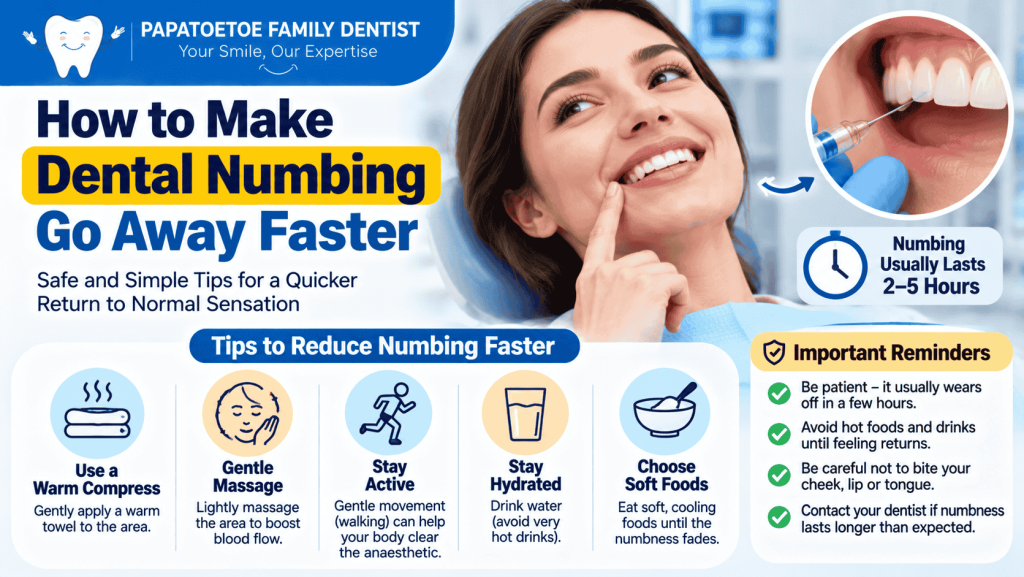
Have you ever visited the dentist for a filling, tooth extraction, root canal, or another dental procedure and noticed that your lips, tongue, cheek, or jaw still feel numb after leaving the clinic?
Dental numbness is a normal effect of local anaesthesia. Dentists use numbing injections to prevent pain and make dental procedures more comfortable. However, the numb feeling can sometimes remain for several hours after treatment, making it difficult to eat, drink, speak, or smile normally.
This often leads patients to ask an important question: How can you make dental numbing go away faster?
The good news is that dental numbness usually wears off naturally as the local anaesthetic leaves the tissues and nerves gradually return to normal sensation. Although there is no guaranteed home remedy that instantly reverses dental anaesthesia, there are ways to stay comfortable and avoid accidental injuries while waiting.
In this guide, we explain how long dental numbness lasts, what may help, what you should avoid, and when you should contact your dentist.
What Causes Dental Numbing?
Dental numbness is usually caused by local anaesthesia administered before a dental procedure.
A dentist injects a local anaesthetic near the nerves supplying the treatment area. The medicine temporarily blocks nerve signals that carry pain sensations to the brain.
Depending on the injection site and procedure, you may experience numbness in:
- Your lips.
- Your tongue.
- Your cheeks.
- Your gums.
- Part of your jaw.
- The area surrounding the treated tooth.
This allows your dentist to perform procedures such as fillings, root canal treatment, tooth extractions, and other dental treatments with significantly less discomfort.
Local anaesthesia is different from general anaesthesia. You remain awake and conscious during the procedure, but the targeted area temporarily loses sensation.
As the medication wears off, normal feeling gradually returns.
How Long Does Dental Numbing Last?
Dental numbness usually lasts between one and several hours, depending on the anaesthetic used and the type of dental procedure.
For example, lidocaine commonly provides around one to two hours of numbness, although the duration can be longer when it is combined with a medicine such as epinephrine.
Other local anaesthetics may last longer.
The exact duration depends on several factors:
Type of anaesthetic: Different local anaesthetic medicines have different durations of action.
Amount administered: The dose and number of injections can influence how long numbness lasts.
Injection location: Some dental injections affect larger nerve areas, which can cause numbness across the lower lip, tongue, or cheek.
Use of epinephrine: Some dental anaesthetics contain epinephrine, which can slow the absorption of the anaesthetic and extend its effects.
Individual response: A person’s health, metabolism, and other individual factors can influence how quickly sensation returns.
It is important to remember that the tooth may regain sensation before the surrounding soft tissues, such as the lips and tongue.
If you have had a more involved procedure, your dentist may explain that numbness could last longer than it would after a routine filling.
1. Be Patient and Allow the Anaesthetic to Wear Off
The safest and most reliable approach is to allow your body time to process the local anaesthetic.
Dental numbness is temporary in most cases. As the medication is absorbed and its effect decreases, the nerves gradually regain their normal function.
Trying to force the numbness to disappear can sometimes create unnecessary discomfort or increase the risk of injury.
If you have recently received a dental injection, follow the aftercare instructions provided by your dentist.
Avoid putting pressure on the affected area, and do not attempt aggressive massage or other techniques to force sensation to return.
2. Stay Hydrated
Drinking enough water is important for general health and helps prevent dehydration.
However, drinking extra water has not been proven to directly reverse dental anaesthesia or make numbness disappear significantly faster.
If your mouth is still numb, take care when drinking. You may not be able to judge the temperature of a drink properly, and liquid may spill because your lips and tongue have reduced sensation.
Choose cool or room-temperature water and drink slowly.
Avoid very hot drinks until normal sensation has returned.
3. Try Gentle Movement When You Feel Comfortable
Once you have recovered sufficiently from your dental procedure, normal light activity may help you feel more comfortable.
Walking around and continuing with gentle everyday activities is generally fine if your dentist has not advised otherwise.
However, there is limited evidence that exercise or movement reliably speeds up the disappearance of dental numbness.
Avoid strenuous exercise immediately after procedures where your dentist has recommended rest, particularly following tooth extraction or oral surgery.
Do not exercise specifically to force the anaesthetic to wear off.
4. Use a Warm Compress Only If Your Dentist Recommends It
Some dental aftercare advice suggests that a warm compress may help improve local circulation in certain circumstances.
However, it is not a guaranteed way to reverse dental numbness.
There are also situations where heat should be avoided, particularly after oral surgery or when swelling is present.
If your dentist recommends a warm compress, use a comfortably warm towel rather than something hot. Never apply excessive heat to an area that cannot properly feel temperature.
Do not place a hot compress directly inside your mouth.
The most important rule is to follow the specific aftercare instructions for your procedure rather than assuming that heat will make numbness disappear faster.
5. Avoid Eating Until You Regain Normal Sensation
This is one of the most important precautions after receiving dental anaesthesia.
When your lips, cheeks, or tongue are numb, you may accidentally bite yourself without realising it.
This can cause:
- Cuts inside your cheek.
- Injuries to your tongue.
- Biting of the lower or upper lip.
- Burns from hot food.
- Difficulty swallowing or controlling food.
It is best to wait until normal sensation returns before eating solid food.
If your dentist has advised that you can eat during the recovery period, choose soft foods that do not require much chewing and follow their instructions carefully.
Avoid hard, crunchy, chewy, and very hot foods while your mouth remains numb.
6. Avoid Touching or Biting the Numb Area
When you cannot feel your lips, tongue, or cheeks properly, you may be tempted to touch the area repeatedly to check whether the numbness has disappeared.
Avoid this habit.
Children are particularly likely to bite their lips or cheeks after dental treatment because they may not understand why the area feels different.
Parents should supervise young children until the anaesthetic wears off.
Avoid:
- Biting your lips to test sensation.
- Chewing your cheeks.
- Repeatedly touching the injection site.
- Scratching numb tissues.
- Applying unnecessary pressure to the affected area.
These actions can cause injuries that may become painful once the anaesthetic wears off.
7. Ask Your Dentist About a Local Anaesthetic Reversal Agent
If you regularly experience prolonged numbness or need to return to normal sensation sooner after treatment, you can ask your dentist whether a reversal agent is an option.
One medication studied for this purpose is phentolamine mesylate, marketed under the brand name OraVerse in some countries.
It works differently from ordinary local anaesthesia. It can help reverse certain soft-tissue anaesthetic effects, particularly numbness involving the lips and tongue after injections containing a vasoconstrictor.
Clinical research has found that phentolamine mesylate can reduce the time needed for normal sensation to return in suitable patients.
However, it is not appropriate for everyone and is not a home treatment.
A dental professional must assess whether it is suitable, taking into account the procedure, anaesthetic used, medical history, and availability of the product.
If you are concerned about prolonged numbness, ask your dentist about this option before or after your treatment.
What Should You Avoid When Your Mouth Is Numb?
While waiting for dental anaesthesia to wear off, certain activities can increase the risk of accidental injury.
Here are some important things to avoid:
Do not eat hard foods: You may accidentally bite your cheek or tongue.
Avoid hot drinks: You may burn your lips or mouth without noticing the temperature.
Do not chew gum: Reduced sensation can make chewing uncomfortable and increase the chance of biting soft tissues.
Do not massage aggressively: Forceful pressure around the injection area can cause irritation or injury.
Avoid testing numbness by biting: This can damage your lips, tongue, or cheeks.
Do not take additional medication to reverse numbness: Never use unprescribed medicines or home remedies to counteract dental anaesthesia.
Following these precautions can make the recovery period safer and more comfortable.
Why Does Dental Numbing Sometimes Last Longer?
Some patients notice that their mouth stays numb for much longer than expected.
This does not always indicate a problem. Several factors can influence the duration of local anaesthesia.
1. A Longer-Acting Anaesthetic
Some anaesthetic medicines are specifically designed to provide longer-lasting numbness.
For example, bupivacaine may be used in certain dental procedures when longer-lasting pain control is needed.
2. Lower Jaw Dental Injections
Injections used to numb the lower jaw may affect a larger nerve area.
This can result in numbness affecting the lower lip, chin, tongue, or several teeth.
As a result, the numb feeling may remain longer than expected.
3. More Extensive Dental Treatment
Procedures such as surgical extractions or complex dental treatments may require different anaesthetic techniques or additional doses.
The numbness may therefore last longer.
4. Individual Differences
Every patient responds differently to local anaesthesia.
Age, health conditions, medication use, and individual differences can influence the duration of numbness.
If your experience is significantly different from what your dentist explained, contact the dental practice for advice.
When Should You Contact Your Dentist About Dental Numbness?
Most dental numbness gradually disappears without requiring additional treatment.
However, you should contact your dentist if:
- Numbness lasts significantly longer than the expected duration.
- You experience persistent tingling or unusual sensations.
- You notice weakness or difficulty moving the affected area.
- The numbness does not gradually improve.
- You experience unusual pain or other unexpected symptoms.
If numbness in your lip, chin, or tongue remains after the expected recovery period, your dentist may need to examine the area and assess whether a nerve-related problem has occurred.
Do not ignore persistent altered sensation, even if it is not painful.
Seek emergency medical attention if you develop difficulty breathing or swallowing, sudden facial weakness, or other symptoms that may indicate a serious medical emergency.
How to Prevent Accidental Injuries After Dental Anaesthesia
You may not be able to control exactly when the numbness disappears, but you can protect your mouth while waiting.
Follow these simple precautions:
- Avoid eating solid food until normal sensation returns.
- Drink cool or room-temperature water carefully.
- Avoid hot drinks and food.
- Do not bite or chew your lips, cheeks, or tongue.
- Keep young children under supervision.
- Follow the aftercare instructions provided by your dentist.
- Contact your dental practice if numbness lasts longer than expected.
These simple habits can help prevent unnecessary discomfort and injuries after dental treatment.
Conclusion
Dental numbing is a normal and temporary effect of local anaesthesia used during dental procedures. Although it can be inconvenient, the feeling usually disappears naturally as the medication wears off.
There is no guaranteed home remedy that can instantly remove dental numbness. Staying hydrated, avoiding accidental bites, following your dentist’s aftercare advice, and allowing your body time to recover are sensible steps.
If prolonged numbness is a concern, speak with your dentist about the anaesthetic used and whether a professional reversal option may be suitable.
At Papatoetoe Family Dentist, we believe that understanding dental treatments and their aftercare helps patients feel more comfortable and confident. If you experience unusual or prolonged numbness after a dental procedure, seek professional advice rather than trying unverified home remedies.
Frequently Asked Questions
1. How long does dental numbing usually last?
Dental numbness often lasts one to several hours, depending on the anaesthetic used, the dose, and the injection location. Some longer-acting medicines can produce numbness for a longer period.
2. Can I make dental numbness go away faster at home?
There is no guaranteed home method that instantly reverses dental anaesthesia. The safest approach is to allow the medication to wear off naturally and follow your dentist’s aftercare instructions.
3. Does drinking water help dental numbness go away?
Drinking water helps maintain hydration, but there is no strong evidence that drinking extra water directly speeds up the reversal of dental anaesthesia.
4. Can I eat while my mouth is still numb?
It is best to wait until normal sensation returns before eating solid food. Eating while numb can cause accidental biting of your lips, cheeks, or tongue. Also avoid hot foods and drinks because you may not feel the temperature properly.
5. Why is my lip still numb after a dental filling?
The injection may affect the nerves supplying your lip and surrounding tissues. Soft-tissue numbness can last longer than the numbness affecting the treated tooth. The duration depends on the anaesthetic and injection technique.
6. Can a dentist reverse dental numbness?
In certain cases, a dentist may use a medication called phentolamine mesylate to help reduce soft-tissue numbness. It is a professional treatment option and is not suitable for every patient.
7. Is prolonged dental numbness dangerous?
Temporary numbness is normal after local anaesthesia. However, persistent numbness, tingling, or unusual sensations should be reported to your dentist so the area can be assessed.
8. Should I massage my face to remove dental numbness?
Do not massage aggressively or apply pressure to the injection area. There is no reliable evidence that forceful massage will reverse dental anaesthesia, and it may irritate the tissues.
9. Why does dental numbness last longer in some people?
The type and amount of anaesthetic, injection location, use of epinephrine, and individual patient factors can all influence how long numbness lasts.
10. When should I worry about numbness after a dental injection?
Contact your dentist if numbness lasts longer than expected, does not gradually improve, or is accompanied by persistent tingling or unusual sensations. Seek emergency care for serious symptoms such as difficulty breathing or swallowing.