What to Study to Become a Dentist: A Complete Guide for Students in New Zealand

Was the Electric Chair Invented by a Dentist? The Surprising History Behind It
October 23, 2026
Are Dental Implants Strong? Everything You Need to Know About Their Strength and Durability
October 23, 2026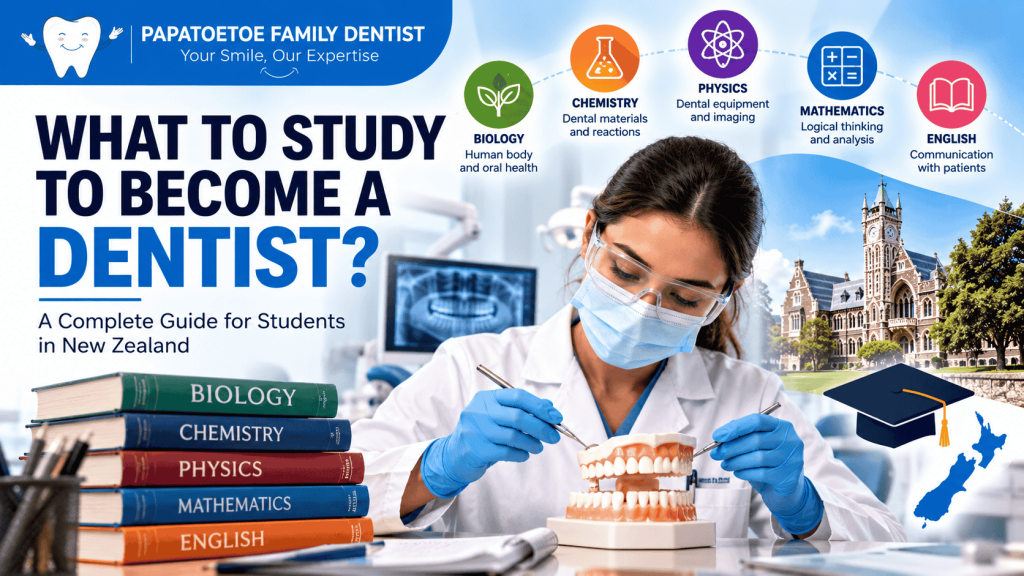
Choosing a career in dentistry can be an excellent option for students who are interested in healthcare, science, and helping people maintain healthy smiles. Dentists play an important role in preventing oral health problems, diagnosing dental conditions, treating tooth decay, and helping patients feel confident about their smiles.
However, becoming a dentist requires more than an interest in teeth. Students need to build a strong academic foundation, complete an approved dental degree, develop practical clinical skills, and meet the professional registration requirements of the country where they want to practise.
If you are wondering what to study to become a dentist in New Zealand, this guide explains the subjects to focus on at school, the university pathway, the skills you need, and the steps involved in becoming a qualified dental professional.
What Do You Need to Study to Become a Dentist?
To become a dentist, you generally need a recognised university-level dental qualification. In New Zealand, the University of Otago offers the Bachelor of Dental Surgery (BDS), which is a prescribed qualification for general dental practice.
Your journey usually begins at secondary school, where subjects such as biology, chemistry, physics, mathematics, and English can help prepare you for university-level study. You then need to meet the university’s admission requirements and successfully complete the required dental programme.
The main steps include:
- Studying relevant science subjects at secondary school.
- Meeting the entry requirements for university study.
- Completing the required initial university study and selection process.
- Gaining admission to an approved dental degree.
- Completing academic, laboratory, and clinical training.
- Applying for professional registration and a practising certificate before working as a dentist in New Zealand.
Admission requirements and selection criteria can change, so students should check the latest information published by the university before choosing their subjects or planning their applications.
1. Which Subjects Should You Study at School?
Choosing suitable subjects at school can help you prepare for the academic demands of dentistry. Although the exact prerequisites depend on the university and the year of application, several subjects are particularly useful for aspiring dentists.
Biology
Biology is one of the most relevant subjects for students interested in dentistry. It introduces you to the human body, living organisms, cells, tissues, and biological processes.
During dental training, you will learn about the structure and function of the mouth, teeth, gums, jaw, and surrounding tissues. You will also study how diseases develop and how the body responds to injury and infection.
A good understanding of biology can help you become familiar with topics such as:
- Human anatomy and physiology.
- Cells, tissues, and organ systems.
- Oral health and disease.
- Microorganisms and infection.
- The body’s healing and immune responses.
Studying biology can provide a useful foundation for understanding the scientific principles behind dental treatment.
Chemistry
Chemistry is another important subject to consider. Dental students need to understand the properties of different materials, chemical reactions, and how substances interact with the human body.
Chemistry can help prepare you for university topics related to biochemistry, dental materials, and the scientific principles behind certain treatments.
For example, dentists work with restorative materials used to repair teeth, and they need to understand how these materials behave. Knowledge of chemistry also supports learning about acids, tooth enamel, and the processes involved in tooth decay.
If you enjoy practical experiments and problem-solving, chemistry may be particularly useful during your preparation for a dental career.
Physics
Physics helps students understand forces, energy, light, radiation, and the behaviour of materials. These concepts can become relevant when studying dental equipment, imaging technology, and certain clinical procedures.
Dental professionals use specialised equipment to examine teeth and diagnose oral health conditions. Understanding the basic principles behind technology can help students approach these subjects with greater confidence.
Physics is also useful for developing analytical thinking and understanding how scientific principles are applied in healthcare.
Mathematics and Statistics
Mathematics supports logical reasoning, numerical accuracy, and problem-solving. These skills are valuable in scientific study and clinical practice.
Dentists may need to interpret measurements, understand research findings, assess treatment information, and evaluate clinical data. Statistics is also useful when learning to interpret scientific studies and evidence about oral health.
You do not need to be a mathematician to become a dentist, but being comfortable with numbers and analytical thinking can make parts of your training easier.
English and Communication
English is important because dentistry involves much more than scientific knowledge. Dentists must communicate clearly with patients, explain treatment options, understand medical histories, and maintain accurate clinical records.
Good communication skills help patients understand their oral health and feel more comfortable discussing concerns.
Students should develop their reading comprehension, writing, listening, and speaking skills. These abilities are especially valuable when explaining procedures, discussing preventive care, and working with colleagues.
Important: Biology, chemistry, physics, mathematics, and English are useful preparation subjects, but they should not be treated as a guaranteed list of compulsory prerequisites. Always check the current University of Otago admission criteria and subject requirements before finalising your school subjects.
2. Which University Degree Is Required to Become a Dentist in New Zealand?
In New Zealand, the University of Otago offers the Bachelor of Dental Surgery (BDS). The Dental Council of New Zealand lists this degree, along with the Bachelor of Dental Surgery with Honours, among the prescribed qualifications for general dental practice.
A dental degree is designed to develop both the scientific knowledge and practical clinical skills required to care for patients.
During dental training, students learn about subjects such as:
- Human anatomy and physiology.
- Oral biology and oral health.
- Dental anatomy and tooth development.
- Oral diseases and their prevention.
- Dental materials and restorative dentistry.
- Periodontal health and gum disease.
- Dental diagnosis and treatment planning.
- Patient communication and professional ethics.
- Infection prevention and clinical safety.
- Practical dental procedures and patient care.
The programme combines academic learning with practical training. Students gradually develop the ability to assess oral health, identify dental problems, plan appropriate care, and carry out treatments within their level of training and competence.
Because dental education involves direct patient care, students must also learn about professional responsibilities, patient safety, confidentiality, and ethical decision-making.
3. How Long Does It Take to Become a Dentist?
The time required to become a dentist depends on your educational background, admission pathway, and the requirements of the dental programme.
In New Zealand, students generally follow a university pathway that includes initial university study and the competitive selection process for professional dental training, followed by the dental degree itself.
It is important to understand that completing secondary school does not automatically guarantee entry into the dental programme. Students must meet the relevant admission criteria and compete for available places where selection is required.
Your overall timeline may also be affected by whether you need to complete additional study, repeat a course, or meet other entry requirements.
Before making a long-term education plan, review the latest programme structure and admission information from the University of Otago. This will help you understand the expected study sequence, selection process, and time commitment.
4. What Is the Admission Process for Dental School?
Admission to a dental degree can be competitive. Students should prepare academically and understand the application process well before the relevant deadlines.
In New Zealand, prospective students should review the University of Otago’s current information about entry into dentistry, including the required initial study, academic performance expectations, application dates, and selection procedures.
A practical preparation plan includes the following steps.
Step 1: Choose Suitable School Subjects
Select subjects that help you develop a strong science background. Biology and chemistry can be particularly useful, while physics, mathematics, and English help build additional scientific and communication skills.
Check the current university requirements rather than relying only on general advice from other students.
Step 2: Research University Entry Requirements
Visit the university’s official programme information to understand the academic qualifications and admission pathway you need.
Pay attention to the required first-year study, course selection, academic performance, and any other conditions that apply to your applicant category.
Step 3: Prepare for Competitive Selection
Where admission is competitive, strong academic performance is important. Build effective study habits, manage your time carefully, and seek academic support when needed.
It is also helpful to understand that selection policies may change between application years.
Step 4: Apply Within the Required Timeframe
Keep track of application deadlines and ensure that all required documents and information are submitted correctly.
If you are an international student or have completed previous study outside New Zealand, check whether additional assessment or documentation is required.
Step 5: Prepare for Clinical Learning
Once admitted, you will need to balance academic study with practical training. Dentistry requires concentration, attention to detail, professionalism, and a willingness to keep learning.
5. What Skills Do You Need to Become a Dentist?
Academic qualifications are essential, but successful dentists also rely on a range of personal and professional skills.
Manual Dexterity
Dentistry involves working carefully in a small, detailed area of the body. Dentists need controlled hand movements and good coordination when examining teeth and carrying out procedures.
Drawing, model-making, crafts, and other activities requiring precision may help you practise coordination, although they are not substitutes for formal clinical training.
Attention to Detail
Small changes in the teeth, gums, and surrounding tissues can provide important information about a patient’s oral health.
Dentists need to observe carefully, assess findings, and make considered decisions based on clinical evidence.
Problem-Solving
Each patient has different needs. A dentist must understand the problem, consider possible treatment options, and develop an appropriate care plan.
Scientific reasoning and the ability to evaluate information are important parts of this process.
Communication and Empathy
Some people feel nervous about dental appointments. A good dentist listens patiently, explains procedures clearly, and treats patients with respect.
Empathy helps dentists understand individual concerns and support patients in making informed decisions about their care.
Patience and Professionalism
Dental procedures can require sustained concentration and careful planning. Dentists must follow infection-control procedures, maintain patient confidentiality, and work within their professional competence.
Professionalism also means recognising when a patient needs a referral to another dental professional or healthcare provider.
6. What Happens After You Complete Your Dental Degree?
Graduating from a dental programme is a major achievement, but there are additional requirements before you can practise independently as a dentist in New Zealand.
The Dental Council of New Zealand regulates dental practitioners and sets requirements for registration and professional practice.
Graduates must follow the applicable registration process and obtain both registration and a current practising certificate before providing dental services in New Zealand.
The registration process depends on your qualification, graduation circumstances, and individual eligibility. Students graduating from an accredited New Zealand programme should follow the Dental Council’s guidance for new graduates.
If you have qualified overseas, do not assume that your degree automatically allows you to practise in New Zealand. The Dental Council assesses qualifications and provides different registration pathways depending on the qualification and circumstances. Some applicants may need further assessment or an examination.
Planning for registration early can help you understand the documents and professional requirements that apply after graduation.
7. Can You Become a Dentist in New Zealand If You Studied Overseas?
Yes, it may be possible, but the process depends on where you studied, the qualification you hold, and whether it is recognised for registration in New Zealand.
The Dental Council has specific pathways for applicants with prescribed qualifications and other pathways for certain overseas-qualified dentists. Applicants whose qualifications are not prescribed may need to complete an assessment or examination, depending on their circumstances.
If you earned a dental degree in a country such as India, you should check the Dental Council’s current registration requirements before assuming that you can work immediately after moving to New Zealand.
The assessment may consider your qualification, training, professional experience, competence, and other registration criteria.
For this reason, students planning an international dental career should research the registration requirements of their intended country before selecting a university. A qualification that allows you to practise in one country does not necessarily provide automatic registration in another.
8. What Career Opportunities Are Available After Studying Dentistry?
A dental degree can open the door to several career paths, depending on your qualifications, interests, experience, and further training.
General Dentist
General dentists assess oral health, diagnose dental conditions, provide preventive advice, and carry out a range of dental treatments. They may work in private practices, community settings, or other healthcare environments.
Dental Specialist
Some dentists pursue further recognised postgraduate education and training in a particular area of dentistry. Specialist fields may include orthodontics, endodontics, periodontology, paediatric dentistry, and prosthodontics.
Specialist registration requires additional qualifications and must meet the relevant Dental Council requirements.
Academic and Research Careers
Dentists with an interest in research or education may pursue opportunities in universities, research projects, and professional training. These roles can contribute to improving dental knowledge, clinical methods, and oral health outcomes.
Public and Community Oral Health
Dentists may also work in services focused on community oral health, prevention, and improving access to dental care. These roles can involve working with different populations and supporting wider oral health initiatives.
Your career options will depend on the experience and qualifications you gain throughout your professional journey.
9. Is Dentistry the Right Career for You?
Dentistry may be a suitable career if you enjoy science, like solving problems, and want to work directly with people. It can be rewarding to help patients manage dental problems, protect their oral health, and feel more confident about their smiles.
However, it is important to understand the commitment involved. Dental education requires consistent study, practical training, and the ability to apply scientific knowledge in real clinical situations.
Before choosing dentistry, ask yourself:
- Do I enjoy biology and other science subjects?
- Am I comfortable learning detailed scientific concepts?
- Can I concentrate on precise practical tasks?
- Do I enjoy communicating with and helping people?
- Am I prepared for several years of demanding education and clinical training?
- Am I willing to continue learning throughout my career?
You do not need to have every skill perfectly developed before applying. Many of these abilities improve through education, practice, and experience. The important thing is to understand the expectations and make an informed decision about your future.
10. Tips for Students Who Want to Become Dentists
If dentistry is your goal, a few practical steps can help you prepare.
Build a strong academic foundation. Focus on understanding scientific concepts rather than memorising information without context.
Research the university pathway early. Learn about admission requirements, application deadlines, programme structure, and selection criteria.
Develop good study habits. Dentistry involves a substantial amount of information, so consistent revision and effective time management are valuable.
Improve your communication skills. Practise explaining ideas clearly, listening carefully, and working collaboratively with others.
Learn about the profession. Where appropriate, seek opportunities to understand dental practice and the responsibilities involved, while respecting patient privacy and clinical rules.
Check official requirements regularly. University admissions policies and professional registration requirements can change. Use the latest official guidance when planning your education.
Think about your long-term goals. Consider where you would like to practise and check whether the qualification you plan to earn will meet that country’s professional requirements.
Conclusion
Becoming a dentist requires a combination of academic preparation, university education, practical clinical training, and professional registration. For students in New Zealand, science subjects such as biology and chemistry can provide a useful foundation, while mathematics, physics, English, and communication skills support broader preparation for dental study.
The University of Otago offers the Bachelor of Dental Surgery, a prescribed qualification for general dental practice in New Zealand. However, admission is subject to the university’s requirements, and graduates must complete the applicable Dental Council registration process before practising.
If you are considering dentistry as a career, start by researching the current entry requirements, choosing suitable school subjects, and developing the scientific and interpersonal skills needed for patient care. With careful planning and commitment, you can take informed steps towards a future in dentistry.
At Papatoetoe Family Dentist, we recognise the important role dental professionals play in supporting healthier smiles and stronger communities. Understanding the education behind the profession can help students make confident decisions about their future career.
Frequently Asked Questions
What subjects should I study to become a dentist?
Biology and chemistry are useful subjects to consider, alongside physics, mathematics, and English. The exact prerequisites depend on the university and admission pathway, so check the latest official requirements before selecting your subjects.
Which degree do you need to become a dentist in New Zealand?
The University of Otago offers the Bachelor of Dental Surgery (BDS), which the Dental Council of New Zealand lists as a prescribed qualification for general dental practice.
How long does it take to become a dentist?
The total time depends on the university pathway, initial study requirements, admission process, and dental programme. Check the current University of Otago programme structure for the expected study timeline.
Can I become a dentist without studying biology?
Biology is highly relevant to dentistry, but whether it is compulsory for your chosen entry pathway depends on the university’s current requirements. Review the official admission information before deciding which subjects to take.
Can an overseas-qualified dentist work in New Zealand?
Possibly. Overseas-qualified dentists must meet the Dental Council’s applicable registration requirements. Depending on their qualification and circumstances, they may need assessment or an examination before they can practise.
Do dentists need to register before practising in New Zealand?
Yes. Dentists must meet the applicable Dental Council registration requirements and hold a current practising certificate before practising in New Zealand.