
Was the Electric Chair Invented by a Dentist? The Surprising History Behind It

How Much Does a Dental Crown Cost in NZ?
September 28, 2026
What to Study to Become a Dentist: A Complete Guide for Students in New Zealand
October 23, 2026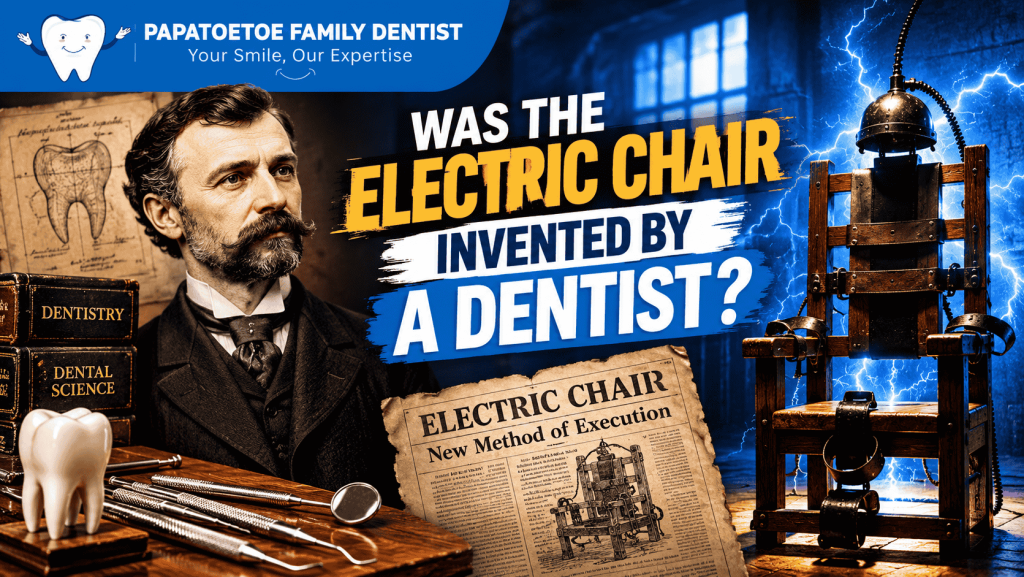
When people think about dentists, they usually imagine dental check-ups, tooth extractions, fillings and healthy smiles. However, one surprising historical fact connects dentistry to something far darker: the electric chair.
Yes, the idea of using electricity for executions was proposed by a dentist named Dr. Alfred P. Southwick in the United States during the 1880s. His proposal eventually contributed to the development of the electric chair, which was first used for an execution in 1890.
But why would a dentist become associated with the invention of an execution method? What inspired his idea, and how did it become part of American history?
The story involves the early development of electrical technology, concerns about traditional execution methods and a historical event that changed the way the United States carried out capital punishment.
In this article, we explore the surprising connection between dentistry and the electric chair, the people involved in its development, and the events surrounding its first use.
Who Was Dr. Alfred P. Southwick?
Dr. Alfred Porter Southwick was an American dentist, dental educator and former steamship engineer who lived in Buffalo, New York.
During the late nineteenth century, electricity was becoming an increasingly important part of modern life. Electrical generators, lighting systems and other technologies were attracting public attention as scientists and engineers explored their potential uses.
Southwick was interested in electricity, and an incident he reportedly witnessed in Buffalo in 1881 influenced his thinking about its effects on the human body.
According to historical accounts, Southwick learned of or witnessed a man dying after accidentally coming into contact with an electrical generator. The incident led him to consider whether electricity could provide an alternative to the execution methods used at that time.
Southwick believed that electrocution might offer a quicker and more controlled method of execution than hanging.
His idea was controversial, but it eventually attracted the attention of officials in New York who were searching for an alternative to traditional capital punishment.
What Inspired the Idea of the Electric Chair?
During the nineteenth century, hanging was a widely used method of execution in the United States.
However, some executions went wrong. These incidents raised concerns about the suffering of condemned prisoners and the reliability of the process.
Reformers and government officials began considering whether another method could make executions more predictable and less distressing.
The growing availability of electricity presented a new possibility.
After considering the effects of an electrical current on the human body, Southwick began advocating for electrocution as a method of capital punishment.
He believed electricity could potentially cause death more quickly than hanging. At the time, some supporters also believed electrocution would be more humane.
These assumptions, however, proved dangerously optimistic. The first execution using the electric chair demonstrated that the method could produce a prolonged and distressing death rather than the quick, painless outcome its supporters had expected.
Did a Dentist Actually Build the Electric Chair?
Although Southwick is credited with proposing and promoting the idea, he was not the sole inventor or builder of the finished device.
This distinction is important when discussing the history of the electric chair.
Southwick helped establish the concept of electrocution as a method of execution. His advocacy contributed to the political and legal process that led New York to adopt the method.
The actual electric chair used in the first execution was designed by Edwin F. Davis, an electrician at Auburn Prison in New York.
Davis developed the apparatus that would deliver the electrical current during an execution.
Therefore, the most accurate way to describe the history is that a dentist proposed the idea, while an electrician designed the chair that was first used.
The development also involved government officials, technical advisers and other individuals who helped turn the proposal into an official execution method.
How Did New York Adopt the Electric Chair?
Southwick’s proposal gained attention during a period when New York officials were examining alternatives to hanging.
In 1886, New York established a commission to investigate methods of carrying out capital punishment. The commission considered the possibility of using electricity.
Southwick became an advocate for electrocution and participated in the process that promoted its adoption.
The idea also emerged during a period of rapid technological change. Electricity was becoming increasingly familiar to the public, and many people believed scientific developments could improve established practices.
In 1888, New York passed legislation establishing electrocution as its method of execution. The law took effect on 1 January 1889.
New York became the first state to officially adopt execution by electricity.
The decision marked a major development in the history of capital punishment in the United States. However, the effectiveness and humanity of the method still needed to be tested in practice.
Who Was the First Person Executed in the Electric Chair?
The first person executed using the electric chair was William Kemmler, a man convicted of murdering Matilda Ziegler.
His execution took place on 6 August 1890 at Auburn Prison in New York.
The event attracted significant public attention because it represented the first practical use of the new method.
Supporters had expected electrocution to provide a relatively quick and controlled death. Unfortunately, the execution did not proceed as planned.
The initial electrical current failed to kill Kemmler. Officials had to prepare and administer a second application of electricity.
Witnesses reported a deeply disturbing scene, and the event received extensive criticism in the press.
Rather than demonstrating a painless and reliable method of execution, the first use of the electric chair revealed serious problems with the technology and its application.
The execution became one of the most widely discussed events in the early history of electrocution.
Why Was the First Electric Chair Execution Controversial?
The execution of William Kemmler was controversial because it failed to deliver the outcome its supporters had promised.
The first electrical application did not immediately kill him, and a second was required.
Witness accounts described the scene as distressing, raising questions about whether electrocution was genuinely more humane than hanging.
The event also demonstrated the risks of adopting a new technology for such a serious purpose before its practical limitations were fully understood.
Despite the criticism, the electric chair continued to be used in the United States. Other states adopted the method in subsequent years.
Its continued use reflected legal, political and public attitudes toward capital punishment during that period.
The history of the electric chair therefore illustrates an important distinction: a technology may be promoted as an improvement, but its real-world consequences can be very different from what its creators or supporters anticipate.
What Was Thomas Edison’s Connection to the Electric Chair?
Another well-known figure associated with the early history of the electric chair was inventor Thomas Edison.
During the late nineteenth century, Edison and industrialist George Westinghouse were associated with competing electrical systems.
Edison supported direct current, commonly known as DC, while Westinghouse backed alternating current, or AC.
This competition became known as the War of the Currents.
As electrocution was being considered for executions, the debate over electrical systems became entangled with the discussion.
Edison participated in efforts to associate alternating current with the dangers of electricity. This was partly connected to the commercial rivalry between the competing systems.
The history is complex, and Edison was not the inventor of the electric chair. Southwick promoted the idea of electrocution, while Edwin Davis designed the chair used in the first execution.
Edison’s involvement illustrates how scientific developments, business interests and public policy sometimes intersect in unexpected ways.
Why Is the Electric Chair Connected to Dentistry?
The connection exists because Alfred P. Southwick’s professional background was in dentistry.
Dentists routinely work with precision instruments, understand aspects of anatomy and use technical equipment in clinical settings. However, there is no evidence that Southwick’s dental practice directly supplied the engineering design for the electric chair.
His contribution was primarily conceptual and political: he advocated using electricity for executions and helped promote its adoption.
This is why the story is frequently described as an unusual fact about the dental profession.
It is also a reminder that historical figures can have professional lives and interests that extend far beyond the work for which they are best known.
Southwick’s legacy is particularly unusual because his dental career is remembered alongside his role in promoting a method of capital punishment.
Did the Electric Chair Prove to Be a Humane Method?
The electric chair was initially promoted as a more humane alternative to hanging.
However, the first execution and later incidents raised serious doubts about that claim.
Electrocution can cause severe physical injury and may not produce immediate death. Historical reports of executions revealed that the method could involve considerable suffering.
The idea that a new technological method would automatically be more humane was therefore challenged by the actual experience of its use.
Over time, different jurisdictions adopted other methods of execution, including lethal injection, although the ethics, reliability and humaneness of execution methods have continued to be debated.
The history of electrocution highlights the importance of examining evidence and real-world outcomes rather than relying only on promises made when a new technology is introduced.
What Happened to Alfred P. Southwick?
Southwick continued to support electrocution as a method of execution even after the first execution generated widespread criticism.
He believed the method could provide an improvement over the execution practices used previously.
However, the failure of the first execution to proceed as expected became a lasting part of the history associated with his proposal.
Southwick’s name remains connected to the development of the electric chair because he helped introduce the idea and advocate for its legal adoption.
His story is now frequently discussed in historical accounts of dentistry, electrical technology and capital punishment.
It is a striking example of how a person’s influence can extend into areas far removed from their primary profession.
Frequently Asked Questions
Was the electric chair invented by a dentist?
The idea of using electricity for executions was proposed and promoted by Dr. Alfred P. Southwick, an American dentist. The chair used in the first execution was designed by prison electrician Edwin F. Davis.
Who was Alfred P. Southwick?
Alfred P. Southwick was an American dentist, dental educator and former steamship engineer who advocated electrocution as an alternative to hanging during the 1880s.
When was the electric chair first used?
The electric chair was first used for an execution on 6 August 1890, when William Kemmler was executed at Auburn Prison in New York.
Why was the electric chair invented?
The method was developed as an alternative to hanging, which was sometimes associated with botched executions. Its supporters initially believed electrocution could provide a quicker and more controlled method of execution.
Did Thomas Edison invent the electric chair?
No. Edison became involved in discussions about electricity and electrocution, particularly during the competition between direct and alternating current systems. Southwick advocated the concept, and Edwin Davis designed the chair used in the first execution.
Was the first electric chair execution successful?
The first execution did not proceed as expected. The initial electrical application failed to kill William Kemmler, and a second application was required. The event generated substantial criticism.
What does this story have to do with modern dentistry?
The connection is historical rather than clinical. Southwick was a dentist, but the electric chair is not related to modern dental treatment or routine dental practice.
Final Thoughts
So, was the electric chair invented by a dentist?
The idea was proposed and promoted by Dr. Alfred P. Southwick, a dentist from Buffalo, New York. However, the chair itself was designed by prison electrician Edwin F. Davis, and its first use took place in 1890.
Southwick’s proposal emerged from nineteenth-century attempts to find an alternative to hanging. What began as an effort to introduce a supposedly more humane method became a controversial chapter in the history of capital punishment.
The story is an unusual reminder that the history of dentistry reaches beyond the dental clinic. It also demonstrates why historical claims need careful context: the person who proposes an idea is not always the person who designs or builds the device that eventually results from it.
For readers interested in dental history, this remains one of the most surprising connections between a dental professional and a major development in American history.